A Spanish Land Grant
The area that would become Rolando Village was originally ranch land tied to Mission San Diego de Alcalá. Following Mexico's secularization of the mission system, Don Santiago Argüello received a land grant for the Rolando area — though land title confusion stemming from the Mexican-American War kept the land from being subdivided for sale until 1885.
A Neighborhood Takes Shape
During California's 1920s expansion boom, Rolando attracted developer interest when the city announced plans to pave University Avenue from Euclid Avenue to La Mesa — opening the corridor that remains the heart of the district today. A 1928 advertisement proclaimed it "San Diego's Largest Residential Project — Where You Will Love to Live!" The rolling hills inspired the name "Rolando," chosen partly for its Spanish appeal in marketing. Development stalled during the Great Depression but the neighborhood's bones were set.
Post-War Growth
The real transformation came in 1949 when the Rolando Village Company (later Lincoln Homes Company) partnered with developer Chris Cosgrove to begin construction. Rolando Park tract homes were swiftly built to meet the soaring demand for housing in post-war San Diego, shaping the neighborhood's distinctive residential character — the charming bungalow streets, the catwalks between houses, and the acorn lampposts that still define Rolando today.
 Rolando Village — via Wikimedia Commons
Schools, Services & a Food Legend
Rolando Park Elementary opened in 1951 and was sold to the San Diego Unified School District in 1955. That same year, entrepreneur Robert O. Peterson pioneered the drive-thru restaurant concept by opening the very first Jack in the Box at 6270 El Cajon Boulevard — right in the heart of Rolando, serving hamburgers for 18 cents with a two-way intercom system. It was a moment that changed American dining forever, and it happened right here.
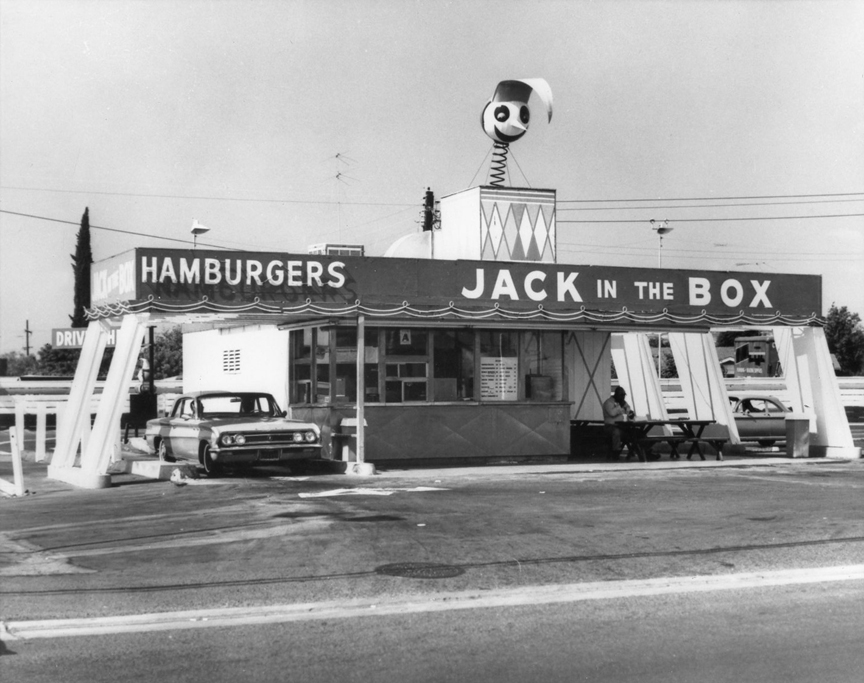 The original Jack in the Box, El Cajon Blvd (c. 1963) — via johnfry.com
Joining San Diego
Residents voted for annexation to the City of San Diego rather than La Mesa, officially making Rolando part of San Diego's growing Eastern Area — the community that now falls within Council District 4. This decision shaped the neighborhood's relationship with city services, infrastructure, and advocacy that continues today through the BID and the Rolando Park Community Council.
A Living Neighborhood
Rolando Village continues to evolve. In 2022, the local post office was renamed the Susan A. Davis Post Office, and in 2024, Henry Clay Elementary was renamed Dr. Bertha O. Pendleton Elementary School — honoring the community's commitment to an inclusive and forward-looking identity. The BID works every day to honor this legacy while building a vibrant future along El Cajon Blvd and University Ave.
 Dr. Bertha O. Pendleton Elementary School (2025) — via Wikimedia Commons
Historical information sourced from Rolando Community Council and rolandopark.org. Photos via Wikimedia Commons and johnfry.com.